

Research & Initiatives
Our vision is to advance fundamental knowledge of cancer biology while laying the foundations for its translation into clinical progress
CELL PLASTICITY PROJECT
Pheochromocytoma and Paraganglioma (PPGL) are highly plastic tumors that can switch between different cellular states to adapt to their environment. Two key states—the pseudo-hypoxic and de-differentiated states—are linked to increased aggressiveness and poorer response to therapy, but the mechanisms controlling these transitions remain unclear. This project investigates how PPGL cells switch between these states and how this affects their invasiveness and treatment sensitivity, using advanced tumor models, multi-omic analyses, and validation in patient samples to identify new targets for more effective therapies.

C-CIRCLES PROJECT
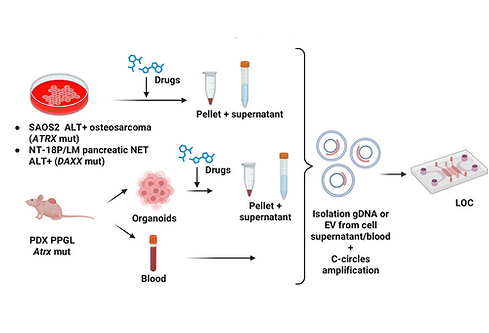
Cancers carrying ATRX or DAXX mutations are often aggressive and therapy-resistant and frequently rely on the Alternative Lengthening of Telomeres (ALT) pathway for survival. This project aims to improve diagnosis and therapy-response monitoring by detecting C-circle DNA, a hallmark of ALT-positive tumors. Using advanced tumor models and a Lab-on-Chip platform that combines isothermal amplification with electrochemical detection, the study will develop a test to identify C-circles in extracellular vesicles and eventually in patient blood samples (liquid biopsies), establishing them as biomarkers for monitoring treatment response.
M13 ONCOLYTIC PHAGES PROJECT
Engineered oncolytic phages can be tailored to display ligands that recognize membrane proteins overexpressed on tumor cells, ensuring highly selective binding and targeted delivery. When these phages are conjugated with the photosensitizer rose bengal, light activation triggers strong ROS production, leading to localized tumor cell death. This dual targeted photodynamic approach has been shown to impair cancer cell viability through receptor specific binding and ROS mediated cytotoxicity while sparing healthy tissues.
In collaboration with the University of Bologna (Prof. G. Perini, Dr. Suleman Zadran), we are exploring the efficacy of oncolytic phages recognizing receptors (e.g., SSTR2) or membrane proteins (e.g., CD276) on neuroendocrine tumor cells for innovative therapeutic approaches.

Neuroendocrine tumors (NETs) characteristically express specific membrane proteins (most notably somatostatin receptors, SSTRs) and this biological feature has historically formed the foundation for targeted therapeutic strategies. As an example, the strong and selective expression of SSTRs has also been exploited for pharmacological treatment of NETs, as well as for diagnostic and radionuclidebased therapeutic approaches using radiolabeled somatostatin analogs. Beyond SSTRs, NETs express additional peptide and growthfactor receptors, as well as antigens that could be exploited for similar therapeutic and diagnostic strategies, reinforcing the longstanding importance of membranebound antigens as therapeutic entry points in NET oncology.
.png)
MEMBRANE RECEPTORS PROJECT
TUMOR MICROENVIRONMENT PROJECT
Pheochromocytoma–Paraganglioma (PPGL) are highly heritable neuroendocrine tumors with significant metastatic potential and limited treatment options once metastasis occurs. In particular, SDHB-mutated PPGLs show the highest risk of aggressive disease, highlighting the need to better understand the mechanisms driving their progression. This project investigates how interactions between tumor cells and the tumor microenvironment contribute to metastatic behavior. Using advanced in vitro models combining genetically defined PPGL cells and patient-derived stromal cells, together with in vivo validation, we aim to identify key molecular mediators of this crosstalk. These insights will support the development of new, targeted therapeutic strategies.

scRNA-seq PROJECT
The adrenal gland relies on coordinated cortex–medulla interactions for proper development and integrated stress responses, and disruptions in this crosstalk may contribute to pheochromocytoma (PCC) progression. Using the MENX rat model, where bilateral PCCs develop with 100% frequency, this project will map cortex–medulla communication at single-cell resolution across disease stages to uncover mechanisms of tumor heterogeneity, lineage evolution, and intercellular signaling (see graphical abstract below). The results are expected to advance understanding of PCC biology and identify novel biomarkers and therapeutic targets.
